Separation of Duties in AI Engineering: Prompt Governance, Auditing, and Knowledge Ownership
Enterprise AI governance cannot depend on a single administrator remembering who changed a prompt, which knowledge source informed an answer, or whether a production release received an independent review. The control objective is straightforward: give people the access they need to do their jobs, but do not let one unchecked identity author, approve, and publish a consequential change.
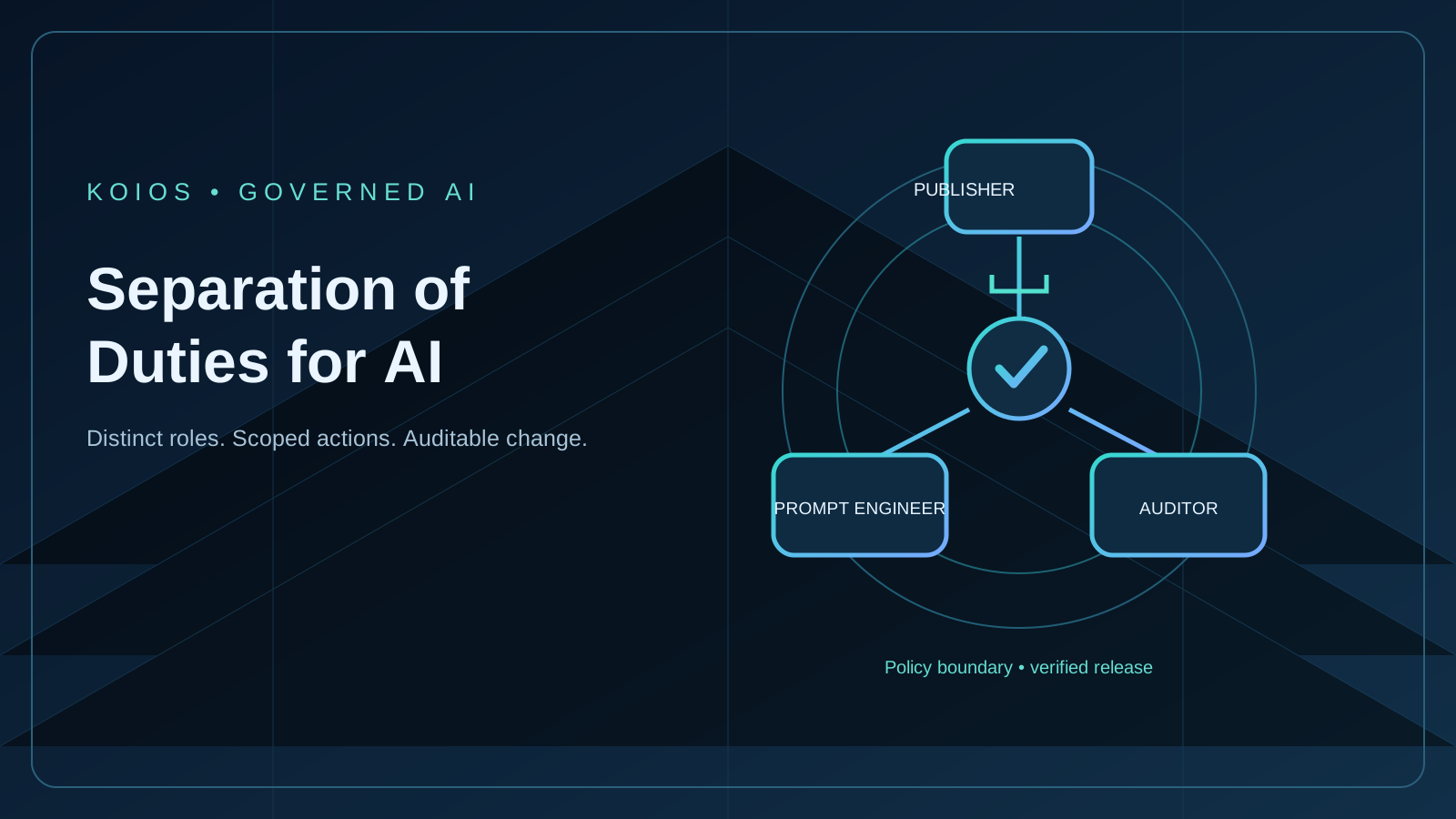
Separation of duties for AI engineering applies a familiar control principle to prompts, agents, tools, and knowledge. Koios positions this as a capability-based governance model: custom roles such as Auditor, Prompt Engineer, Knowledge Manager, and Publisher receive granular actions, while protected operations can require a capability such as action:publish-to-prod. Combined with organizational scoping and asynchronous audit events, these controls help teams make the release path explicit rather than relying on informal convention.
Why AI changes need stronger ownership controls
A prompt is executable policy in all but name. A small instruction change can alter what an agent says, what data it retrieves, and which tools it invokes. A knowledge-base update can change the evidence available to the same agent. A connector or scope adjustment can affect where that work occurs. When one account can edit the instruction, alter its sources, bypass review, and push it live, a mistake or compromised credential has an unnecessarily large blast radius.
The risk is not limited to malicious action. Common operational causes include a hurried emergency fix, an unreviewed copy-paste from staging, contradictory instructions accumulated over time, or a well-intentioned knowledge update that changes a regulated workflow. Without clear ownership, teams struggle to answer basic questions: who proposed this change, who verified it, who authorized production, and which audience or organizational unit was affected?
Generic Admin/User roles do not answer those questions. They collapse distinct responsibilities into broad permissions, making least privilege hard to enforce and review difficult to evidence. AI systems need controls that follow the action and the resource—not merely a job title.
Model duties as capabilities, not job titles
Start by defining the protected actions in your lifecycle. A practical role model separates four duties:
| Role | Primary responsibility | Boundary to preserve |
|---|---|---|
| Prompt Engineer | Draft and revise agent instructions in an authorized environment | May propose changes without automatically approving production release |
| Knowledge Manager | Own approved source material, organization, and update quality | Content stewardship does not imply authority to publish agent configuration |
| Auditor | Review evidence, access decisions, and change records | Read and inspect without silently modifying the subject being audited |
| Publisher | Authorize or perform an approved production promotion | Publishing capability is explicit and limited to designated people and resources |
These are responsibilities, not universal templates. In a small team, an individual may wear more than one role; high-impact production changes should still receive an independent check wherever practical. In larger organizations, duties can be separated across departments, business units, or customer environments.
Implement each permission as an action-specific capability. Reading an agent is different from editing its prompt; editing is different from executing a tool; and staging a change is different from publishing it to production. The capability action:publish-to-prod illustrates the distinction: it represents a protected release action rather than a broad administrator label. Assign it narrowly, evaluate it at the protected operation, and make the decision explainable.
Build a governed change path from draft to production
A dependable release process makes both the artifact and its owner visible at each stage. It does not require a heavyweight committee for every punctuation fix; it requires proportionate controls for changes with meaningful impact.
- Scope the change. Identify the agent, prompt, knowledge base, connector, environment, and organizational branch affected. Establish a known baseline and define the intended behavior.
- Make the change in a non-production context. The Prompt Engineer or Knowledge Manager owns the draft within their authorized scope. Keep the change focused and document its rationale.
- Review independently. A qualified reviewer checks behavior, data access, policy alignment, and test evidence. For a sensitive workflow, the reviewer should not be the sole author and approver.
- Test the relevant boundaries. Evaluate representative requests, expected refusals, retrieval scope, tool permissions, and failure paths. Verify the intended audience can access the resource and adjacent audiences cannot.
- Authorize release explicitly. A Publisher with the required capability approves the production action. Where the platform supports a promotion flow, use that protected route rather than copying configuration by hand.
- Observe and retain evidence. Record the actor, action, target, time, and outcome. Monitor for unexpected behavior and retain a rollback plan appropriate to the system.
This separation helps transform a vague “someone approved it” claim into an auditable chain: change owner, independent reviewer, authorized release, and observable result.
Connect identity, resource scope, and audit
Authorization should be evaluated in context. A user might be entitled to edit one department’s support agent but not a finance knowledge base. They might inspect a published configuration while lacking permission to change it. Role membership therefore needs to work alongside resource scope and action-specific capabilities.
Koios describes organizational governance using hierarchical OrgNode scopes and transitive ReBAC: resources such as agents, knowledge bases, workspace files, and connectors can be associated with branches of an organization. PostgreSQL recursive common table expressions support inherited access through that hierarchy. The practical implication for duty separation is important: the same capability can be constrained to the resources and organizational units where it is needed, rather than becoming a global privilege.
Auditing completes the control loop. Koios messaging identifies asynchronous, non-blocking governance logging (OiAuditLog) for actions such as prompt edits, role assignments, file deletions, and tool execution. For operational use, confirm that your audit policy captures the fields your reviewers need—actor, action, target, timestamp, outcome, and appropriate context—while avoiding unnecessary sensitive prompt or credential content. Logs should support investigations without becoming a new data-exposure surface.
These layers answer different questions:
| Control | Question answered | Example |
|---|---|---|
| Identity and role | Who is acting, and what duties are assigned? | Prompt Engineer versus Auditor |
| Capability | Which operation may this actor perform? | action:publish-to-prod |
| Resource scope | Which agent, knowledge base, or organizational unit is in bounds? | Regional support resources only |
| Audit record | What happened, when, and under whose authority? | Prompt update followed by reviewed release |
Design reviews that test controls, not paperwork
A review should challenge the actual authorization boundary. Can a Prompt Engineer modify a protected production prompt directly? Can an Auditor change the artifact under review? Does a Publisher have access to unrelated business units? Can an agent retrieve a source outside its approved knowledge scope? Are denied actions visible to the people responsible for monitoring?
Translate these questions into repeatable tests. Test positive cases for authorized users and resources, and negative cases for users, actions, and branches that must be denied. Include lifecycle transitions: draft, review, approval, production release, and rollback. A policy that works only in the normal case but fails open on a missing scope or identity attribute is not an effective separation-of-duties control.
Use recognized control frameworks as a review aid, not as a claim of automatic compliance. NIST SP 800-53 Rev. 5 includes AC-5, Separation of Duties, and AC-6, Least Privilege; teams can map their AI change process to those control objectives in the context of their own assessment. See the NIST SP 800-53 Rev. 5 publication. For related governance context, review Koios articles on transitive ReBAC and enterprise AI multi-tenancy and granular AI resource scoping.
Common failure modes and practical remedies
- Admin as the default. Broad access is convenient until a production incident. Define action-specific roles and grant only what the workflow requires.
- Author self-approval. A review checkbox does not create independence if the same person controls every stage. Separate or escalate high-impact approvals.
- Role names without enforcement. A role called “Auditor” is meaningless if it can change the evidence. Tie role definitions to enforceable operations and test both allowed and denied paths.
- Global permissions for local work. Scope roles to the relevant organization branch and resource. Revisit access when teams or responsibilities change.
- Logs that capture too much—or too little. Preserve enough metadata to establish accountability while minimizing secrets and sensitive content. Validate retention and access policies.
- One-time governance design. Review role assignments, exceptions, and emergency access periodically. Remove temporary grants when their purpose ends.
A practical operating model for AI governance
For each production AI workflow, maintain a lightweight ownership matrix: artifact owner, knowledge owner, reviewer, publisher, and incident contact. Define what constitutes a material change, which tests are required, when an independent review is mandatory, and how emergency changes are recorded and reviewed afterward. Make environment boundaries explicit and link each production artifact to its approved source and release record.
Then verify that the platform enforces the model. Koios’s capability-based roles, protected publish-to-production action, organizational ReBAC scope, and asynchronous audit events provide architectural building blocks for this work. They do not replace your organization’s policy, risk assessment, or validation duties; rather, they give teams concrete authorization boundaries to map policy onto.
Good AI governance is not a gate that slows every change. It is a clear chain of ownership that lets the right people move quickly without granting every actor the keys to production.
When responsibilities are distinct, scope is explicit, and actions leave reviewable evidence, enterprises can evolve AI systems with fewer blind spots. Start with the highest-impact workflow, test the boundaries, and expand the model as usage grows.