The Autonomous Task Watchdog: Fault Tolerance for AI Agent Swarms
Agent workflows cross boundaries: a parent dispatches work, a worker calls a model or connector, and dependent steps await a result. A provider can stall, a worker can disappear after claiming a task, or a completion notification can be lost. The most costly failure may be a task that remains marked as running and blocks a workflow without producing a visible error.
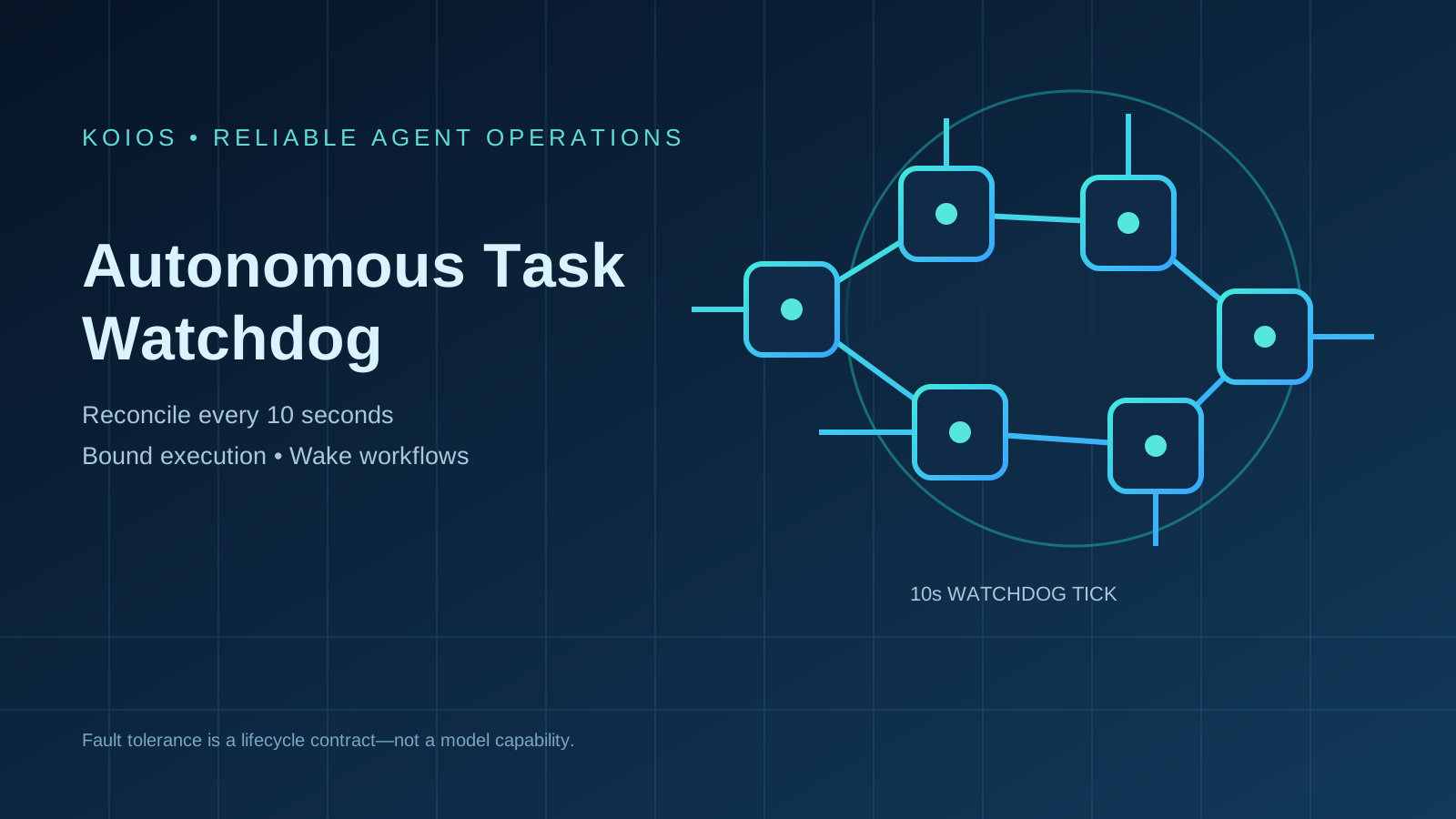
Koios describes an autonomous task watchdog that reconciles task state every 10 seconds, enforces a five-minute execution ceiling, and helps wake parent workflows when child work completes. For SREs, the value is bounded failure: a silent zombie task can become a known terminal state that orchestration and operators can act on.
Important distinction: a watchdog does not make a failed provider call succeed, and timeout is not proof that an external side effect was cancelled. It complements worker callbacks with an independent lifecycle backstop.
Why agent queues accumulate zombie work
Multi-agent systems add worker ownership, provider calls, dependencies and asynchronous completion. Common trouble includes provider timeouts, worker restarts, missing callbacks, and downstream tasks waiting on prerequisites that never become terminal. Retries alone can amplify this: an ambiguous worker state may lead to endless waiting or duplicate work. A watchdog adds a control loop that compares durable lifecycle state with timeout policy. It is not a replacement for idempotency, provider timeouts, or a deliberate retry budget.
How a 10-second reconciliation tick works
The platform messaging guide documents a background watchdog that runs every 10 seconds. Conceptually, it inspects task lifecycle state, marks work that exceeds its maximum runtime as failed, and coordinates wakeups for parents waiting on completed subtasks. The specified ceiling is five minutes.
every 10 seconds: inspect active tasks; fail work beyond its execution ceiling; re-evaluate dependencies; wake eligible parents.This is a conceptual illustration, not a claim about the exact database query. Independent reconciliation means recovery need not depend on the original worker remaining alive to report. Actual detection timing also depends on watchdog health, so its heartbeat needs monitoring.
Bounded execution and terminal states
Without an execution ceiling, a task can remain running indefinitely. With one, the system can transition it to a failure state with timeout context and let the parent or operator decide whether a retry is safe. Five minutes is a documented platform policy, not a universal timeout; teams should tune deadlines by task class and service objective.
| Condition | Without reconciliation | With watchdog policy |
|---|---|---|
| Worker disappears | Task can occupy capacity indefinitely | Overdue task is detected and failed |
| Provider stalls | Parent may wait without terminal signal | Runtime bound enables terminal transition |
| Child finishes | Parent may remain dormant | Completion can trigger parent wakeup |
| Watchdog stops | Stale work remains unresolved | Heartbeat alerting is required |
A timeout does not cancel remote work unless the provider or connector supports cancellation. Use idempotency keys for side-effecting operations, correlate external request IDs with task IDs, and validate late callbacks against durable state.
Parent wakeups keep task DAGs moving
A parent waiting on child tasks should not spend model turns repeatedly asking whether they have finished. When child state changes, orchestration can re-evaluate dependencies and wake the parent when prerequisites are satisfied. Persisted task state should remain the source of truth; notifications can be delayed or duplicated. The parent then chooses whether to continue, retry a safe branch, skip optional work, or fail with context.
Watchdog versus worker callback
| Mechanism | Responsibility |
|---|---|
| Worker callback | Report normal completion or known error promptly |
| Watchdog | Bound execution and detect stale or unreported work |
| Parent orchestrator | Resolve dependencies and choose recovery |
| Monitoring | Alert on queue and control-loop failures |
Healthy workers should call back promptly; callback-only designs leave silent failures unbounded. Separating execution, reconciliation and recovery policy makes lifecycle behavior easier to reason about.
SRE controls to add
- Monitor oldest task age for queued, running and parent-waiting states.
- Track timeout counts, retries, late completions and repeated transitions by task class.
- Expose last successful watchdog tick; alert when reconciliation stops.
- Make status transitions idempotent to prevent duplicate side effects.
- Record task and parent IDs, attempt number, worker, start time, deadline and sanitized error context.
- Set timeout and retry budgets per workload; validate against user-facing SLOs.
- Failure-test worker termination, delayed provider responses, dropped notifications and reconciler restarts.
Observability should not leak prompts, credentials or sensitive content. Prefer typed timeout reasons, correlation IDs and a clear retryability signal over a generic failure label.
What a watchdog does—and does not—guarantee
A reconciler improves boundedness; it does not provide exactly-once execution. A missing response cannot prove that a remote operation never happened. Durable state, idempotent operations and careful late-result handling remain necessary. A five-minute ceiling does not mean every task finishes in five minutes; it defines what the system does when it does not.
Koios positions this control within an enterprise AI execution harness: DAGs coordinate parallel work, callbacks report outcomes, and the watchdog enforces bounded task lifecycles. The result is not immunity from failure; it is failure made visible, measurable and recoverable.
Conclusion: make failure a managed state
Reliable agent swarms assume workers, networks and model providers will sometimes fail. Durable ownership, bounded execution, explicit transitions, parent wakeups and operational monitoring prevent silent work from consuming capacity forever. Ask not only whether the model answered, but whether every task reaches a known outcome and whether dependencies can recover.
Related reading: The Anti-Freeze Callback Protocol and Koios Super General Agent and DAG execution.