Securing AI Connectors: Keep Master API Keys Outside the Agent Runtime
AI credential isolation is a system-boundary decision, not a prompt-writing exercise. If an agent runtime or workflow orchestrator receives a long-lived enterprise secret, prompt injection or runtime compromise can turn it into unintended authority. The safer pattern keeps credentials in a trusted backend and exposes narrow, authorized operations.
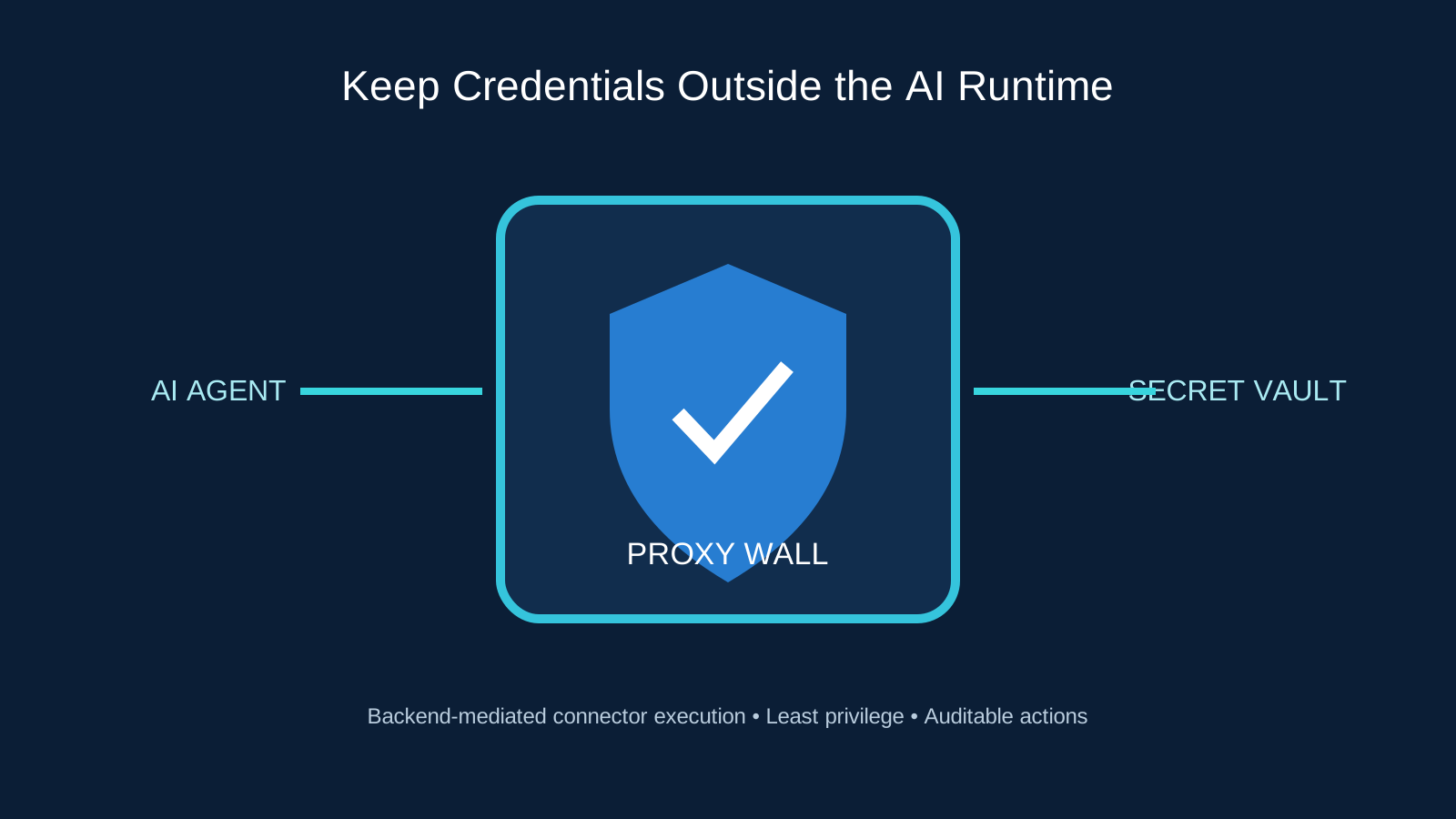
Koios describes a Node.js Proxy Wall in which workflow engines such as n8n or Python runtimes do not receive master API credentials. A backend connector layer signs outbound requests in-flight and returns sanitized results. This reduces exposure, but does not remove the need for authorization, egress controls, audit, and careful response handling.
Why secret placement changes the risk
Secrets carry authority: a CRM token may read customer records, while an ERP credential may permit consequential changes. Putting that authority in an LLM context, tool configuration, or execution environment expands the number of systems that could expose it through logs, traces, debug output, errors, or model-visible content. Prompt instructions are not a security boundary; the stronger move is to ensure model-facing runtimes never possess the raw credential.
How a backend proxy wall works
- The agent requests a constrained operation, not a general-purpose secret.
- The backend authenticates the caller and checks tenant and resource permissions.
- The backend retrieves credentials from protected custody; workflow runtimes do not receive master keys.
- The backend builds and signs the external request.
- It filters the response to the minimum data the workflow needs.
- Rate limits and audit controls bound and record the action.
Agent runtime: typed operation + scoped parameters (no secret) → backend connector proxy: authenticate, authorize, retrieve secret, sign → external API → proxy filters responseProxy wall versus passing keys to workflows
| Design | Exposure | Trade-off |
|---|---|---|
| Key in prompt/tool arguments | May enter model context and traces | Disclosure hard to bound |
| Key injected into workflow | Workflow nodes, logs, exports, hosts may access it | More systems handle secrets |
| Backend-held key | Agent sees inputs and filtered outputs | Central policy, rotation, audit and egress point |
Design the proxy as a policy enforcement point
A proxy is not inherently safe. Avoid arbitrary URL fetches or unrestricted passthrough; validate destinations and parameters, apply tenant-aware access checks, and constrain each action. OWASP’s Top 10 for LLM Applications helps threat-model prompt injection and excessive agency. Follow the OWASP Secrets Management Cheat Sheet for secret handling.
- Least privilege: restrict service credential scopes, tenant and object access.
- Tenant separation: resolve credentials from trusted server identity, not model-supplied tenant IDs alone.
- Input validation: expose typed operations; reject unexpected fields and general request tunnels.
- Egress defense: validate outbound destinations and block private-network and metadata IPs.
- Secret hygiene: keep secrets out of prompts and logs, encrypt storage, rotate and revoke on schedule.
- Response hygiene: return only necessary fields; redact tokens, personal data and diagnostics.
- Abuse controls: add per-tenant limits, timeouts, size limits and bounded retries.
- Auditing: record actor, action, resource, outcome and timestamp without recording credentials.
Failure modes to anticipate
Overly broad proxy operations can recreate risk through arbitrary URLs or raw headers. Model-supplied organization IDs must be validated against authenticated context. Upstream errors may disclose sensitive diagnostics, so return safe errors to the model and retain necessary details in protected observability. Bound retries to avoid storms, and remember that proxies cannot compensate for overprivileged credentials.
Implementation checklist
| Control | Verification question |
|---|---|
| Secret custody | Can the raw key enter an agent, workflow export, or model trace? |
| Action scope | Does each connector action expose only approved operations and parameters? |
| Authorization | Are identity, tenant and resource rights checked server-side on every call? |
| Network boundary | Are destinations validated, with private and metadata IPs blocked? |
| Observability | Do logs describe actions without persisting secrets or sensitive payloads? |
| Resilience | Are timeouts, rate limits, bounded retries and safe failures in place? |
The goal is not to make an agent trustworthy with a master key. The goal is to avoid giving it one.
Where Koios fits
Koios positions its Node.js Proxy Wall as a backend-mediated connector path: execution runtimes do not receive master credentials, the backend signs requests in-flight, and responses are sanitized. Enterprise teams still need least-privilege scopes, credential rotation, tenant policy, and operational review.
Conclusion
A Node.js proxy wall reduces blast radius when implemented as a strict, tenant-aware connector boundary. Combined with least privilege, validated inputs, egress defense, response minimization and audit, credential isolation makes AI connector security an enforceable architecture rather than a prompt convention.