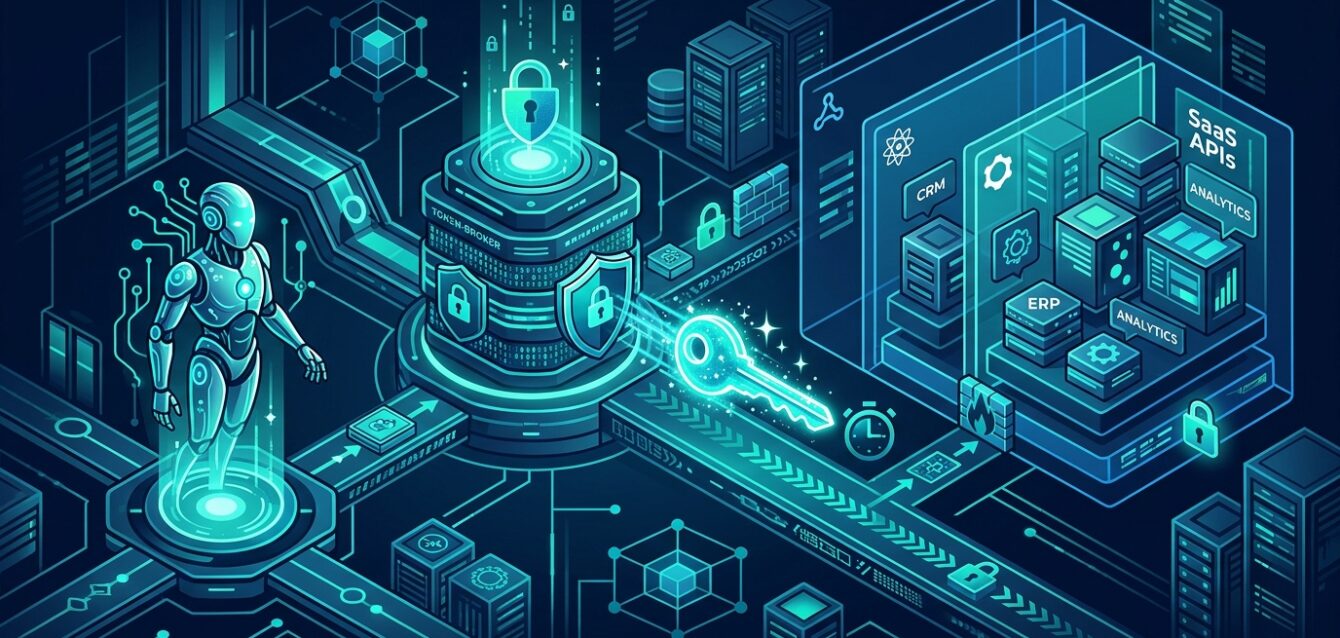
Enterprise integrations increasingly rely on machine identities. An AI workflow may need to read a Box document, retrieve a Salesforce record, or query Microsoft Graph without a person signing in for every operation. The challenge is obtaining the right short-lived credential for the right tenant and operation, and recovering safely when it expires.
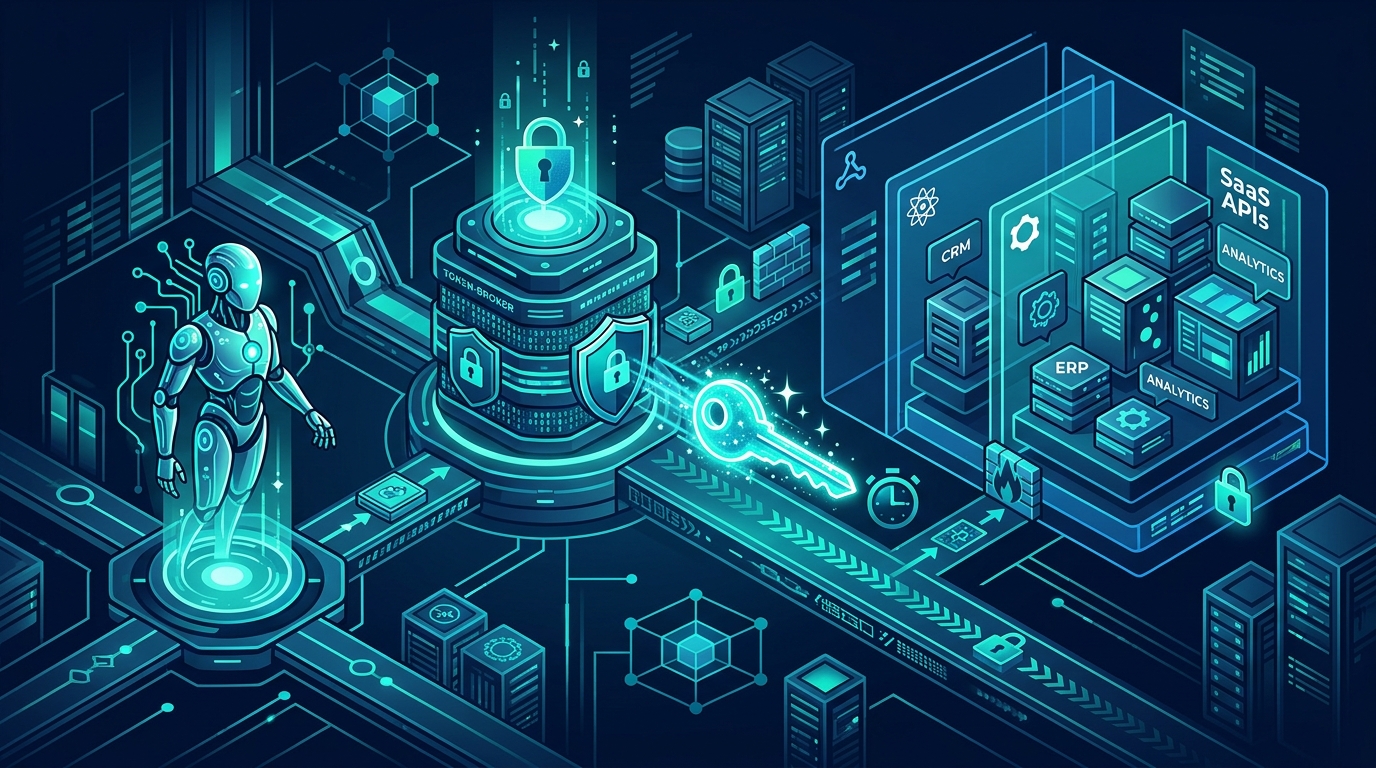
Dynamic M2M authentication for AI matters because autonomous agents can initiate tool calls repeatedly and concurrently. Long-lived static keys embedded in workflows increase exposure and complicate rotation. A controlled authentication layer brokers credentials outside the model context, exchanges approved client credentials for time-limited access tokens, and mediates the API request. Koios positions this within its Enterprise AI Harness: operational access is governed by the platform, not delegated to the language model.
Why static connector secrets become an operational liability
Static API keys may be long-lived, broadly scoped, duplicated across environments, and difficult to rotate without interruption. If copied into prompts, logs, workflow exports, or debugging traces, every copy becomes a potential exposure. Agent workflows add concurrency: several workers may call the same service just as a token expires. Without coordination they can stampede the authorization endpoint with redundant exchanges; unbounded retries can turn one failure into a loop.
The objective is not to give a model a better key. Credentials belong in a controlled backend, scoped to an organization and connector, with explicit acquisition, expiry, caching, retry, and audit behavior.
The two-step M2M authentication lifecycle
Koios messaging describes a two-step lifecycle: acquire or refresh an access token from the identity provider, then use it in the connector request. The agent requests an allowed operation but never handles the client secret or performs the exchange itself.
- Resolve trusted connector context. Identify the organization, connector, credential reference, and permitted request. Reject missing or unauthorized tenant context.
- Acquire a usable token. Check the tenant-aware cache; when needed, exchange protected credentials using the provider’s OAuth2 client-credentials flow and store the token with its expiry.
- Call the API. Attach the access token server-side and send only parameters that pass authorization and validation.
- Recover deliberately. For an eligible expired-token response, invalidate the stale entry, coordinate refresh, and retry under bounded rules.
OAuth2 client credentials is a common machine identity pattern. Token endpoints, scopes, audiences, and error semantics vary by provider, so each connector must follow its documented contract.
Tenant-aware token caching
Fetching a fresh token for every call adds latency and identity-provider load. Caching helps, but a key that omits organizational context risks crossing tenant boundaries. Bind token identity to the organization and connector, plus account or scope dimensions where needed. Track expiry; do not put tokens into model messages, user-visible errors, or general workflow payloads. Koios messaging describes multi-tenant Redis caching and AES-256-GCM encryption for vault secrets; verify the controls enabled in your deployment.
| Concern | Weak pattern | Safer pattern |
|---|---|---|
| Credential location | Secret in prompt or workflow node | Backend-held protected reference |
| Cache boundary | Shared key without tenant context | Organization- and connector-aware key |
| Expiry | Assume token remains valid | Track lifetime and refresh deliberately |
| Failure | Retry indefinitely or expose raw response | Bounded retry with sanitized errors |
Redis mutexes prevent token stampedes
If twenty workers observe an expired token simultaneously, uncoordinated refresh can produce twenty exchanges. A distributed mutex—often using an atomic set-if-absent operation with a short lease—lets one worker refresh while others wait briefly, re-check the cache, and reuse the result. Set bounded waits and account for lock-holder failure. A mutex prevents duplicate work, not unauthorized access: tenant validation, relationship-based authorization, request-schema checks, and safe egress remain essential.
validate tenant and permission → read token cache → acquire refresh mutex if needed → re-check cache → exchange once and cache expiry → call provider → eligible 401: invalidate, refresh, retry once → sanitize and auditSelf-healing 401 recovery without retry loops
A 401 is a signal to inspect, not permission to retry everything. Distinguish authentication failures from authorization failures, invalid inputs, rate limits, and transient network errors. For an eligible expired-token response, invalidate the cache entry, coordinate refresh, and retry once. If it still fails, stop and return a useful sanitized error with a correlation identifier—never authorization headers or token payloads.
Retries must account for idempotency. Repeating a read may be safe; a write could have succeeded upstream even if its response was lost. Use provider idempotency mechanisms or verify the result before replaying a mutation.
Security controls around the token broker
Dynamic exchange is one layer, not a complete security architecture. The broker still needs authenticated callers, authorization for each connector action, tenant isolation, request validation, rate limits, safe outbound destinations, secret protection, and sanitized audit events. Koios describes a defense-in-depth gateway and Node.js proxy wall in which execution engines do not receive master API keys. These controls reduce credential exposure but must be configured and tested for each deployment.
- Least privilege: request only the scopes and audience required.
- Secret custody: keep secrets and tokens out of prompts, tool schemas, and client-side code.
- Tenant isolation: derive tenant identity from trusted server context.
- Abuse resistance: rate-limit exchanges and bound retries.
- Observability: record actor, tenant, decision, outcome, and correlation ID—never the raw token.
Implementation checklist
- Confirm each provider’s flow, scopes, audience, token lifetime, and error semantics.
- Store secrets in a protected backend vault, never in agent instructions or conversation history.
- Define tenant-aware cache keys and expiry policy with a refresh safety margin.
- Coalesce simultaneous refreshes with a distributed mutex or SingleFlight pattern.
- Separate eligible 401 recovery from 403 authorization failures; bound retry attempts.
- Test concurrent expiry, provider outages, revoked scopes, tenant crossover, and ambiguous write outcomes.
- Review sanitized audit events and alert on unusual exchange volume or repeated failures.
From credential plumbing to governed execution
Machine credentials are part of the execution plane, not an AI model’s reasoning context. Separating token acquisition from tool selection, caching within tenant boundaries, coordinating refreshes, and treating authentication failures as bounded state transitions helps make integrations resilient without giving models custody of secrets.
For related reading, see zero-trust security controls for AI agents and SingleFlight coalescing for concurrent agents. For protocol details, consult the OAuth 2.0 client credentials grant.
Connector behavior varies by provider and deployment. Validate implementation details against current product documentation and your threat model.