SingleFlight Request Coalescing: Stop the AI Agent Thundering Herd
Parallel agents divide work, but they can also create a concurrency problem: several workers ask the same external service the same question at nearly the same moment. The result is duplicate upstream traffic, avoidable latency, repeated payload processing, and sometimes bursts of HTTP 429 rate-limit responses.
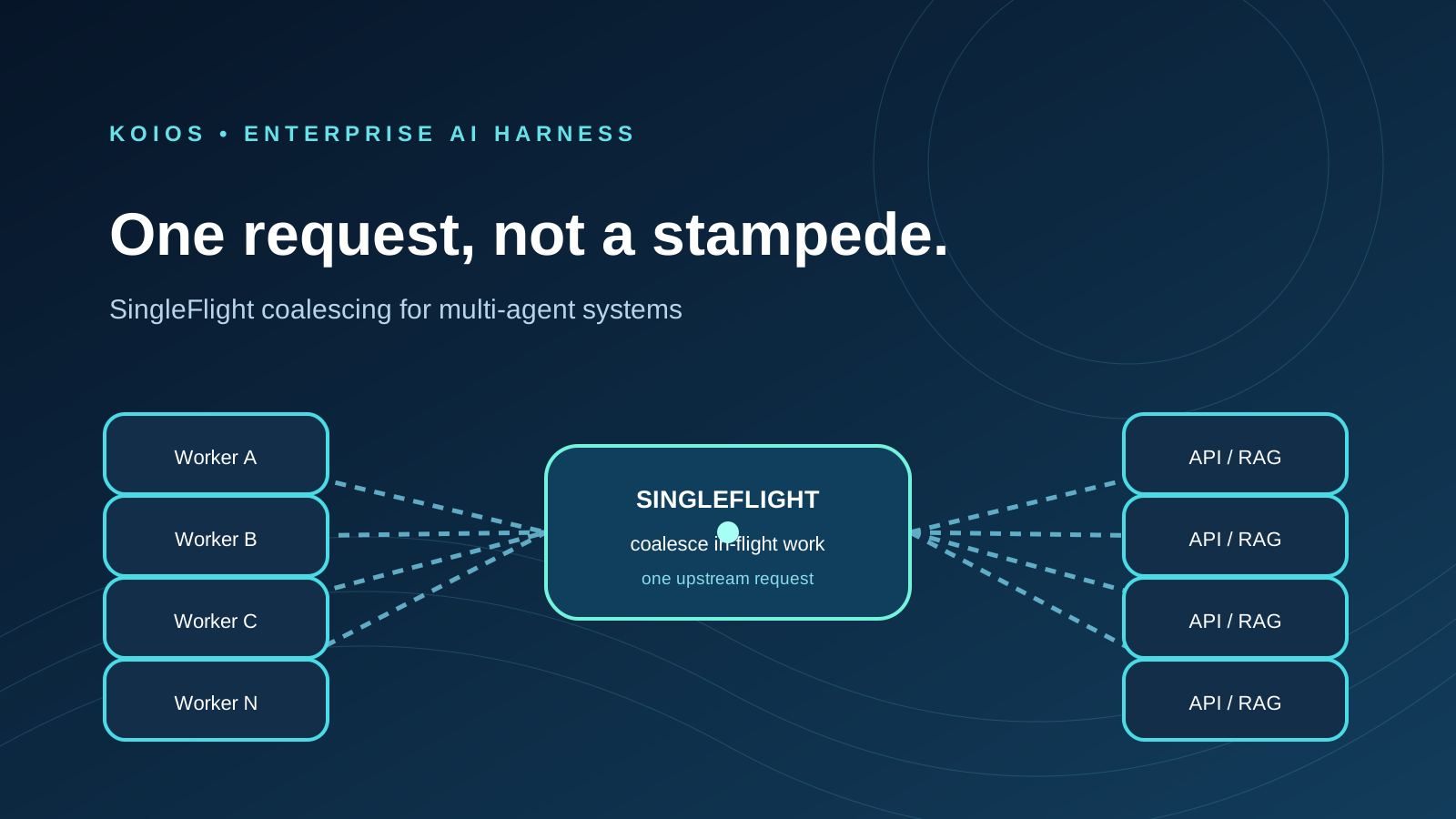
SingleFlight request coalescing addresses this failure mode. Instead of sending every equivalent request independently, a gateway lets one operation for a given key remain in flight while matching callers share its outcome. Koios positions this pattern alongside distributed Redis mutexes in its execution harness and connector gateway: coordinate duplicate work before it amplifies across workers.
This is not a universal cache or a replacement for rate limits, retries, and sound API design. It is a targeted concurrency control for equivalent requests that overlap. This article explains the herd problem, safe key design, failure handling, and useful metrics.
How parallel agents create a request herd
Imagine an orchestrator starts six workers to prepare a customer brief. Each needs the same account profile or knowledge-base result. If workers call independently, six upstream requests are issued for one logical read. Across simultaneous workflows, this fan-out can become a burst.
Each duplicate response must be transferred, parsed, and potentially added to worker context. Upstream queues increase latency. If a provider limit is crossed, it may return 429 responses; uncontrolled retries add more load. The orchestrator waits for workers that all depend on the same fact.
| Without coalescing | With in-flight coalescing |
|---|---|
| Equivalent simultaneous calls each reach the provider | One equivalent operation is sent upstream |
| Duplicate response transfer and parsing | Waiting callers reuse the shared outcome |
| Fan-out magnifies rate-limit pressure | Concurrent duplicate pressure is reduced |
The timing matters. A completed-response cache helps after a value has been stored. But when several requests arrive before the first response is cached, each can miss and race upstream. SingleFlight addresses this cache-miss gap.
What SingleFlight does—and does not do
For a particular key, the first caller becomes the leader and starts the operation. Other callers with the same key wait rather than launch duplicates. When it completes, its outcome is delivered to waiting callers. SingleFlight alone concerns overlapping work; it does not necessarily retain results for later requests.
Matching callers → key lookup → one upstream request → shared outcomeA single process can coordinate active promises in memory. Separate instances in a horizontally scaled system do not share that map, so requests may still duplicate across instances. Koios’s platform messaging describes SingleFlight together with distributed Redis mutexes to coordinate work across workers or gateway instances. Verify actual lock lifecycles, timeouts, and caching behavior in a given deployment rather than inferring them from the pattern name.
Design keys around request meaning and access scope
Key design is critical. A key that is too broad can merge requests with different authorization or response semantics; a key that is too narrow misses equivalent requests. A safe key generally represents the provider or connector, operation, normalized response-shaping parameters, tenant or organization scope, and any identity boundary that changes the response.
| Key decision | Risk | Question to ask |
|---|---|---|
| Tenant and authorization scope | Cross-tenant or over-privileged sharing | May both callers see precisely this response? |
| Request parameters | Different queries collapse together | Are all output-shaping inputs represented? |
| Identity-sensitive headers | Incorrect reuse across user context | Which headers affect access or output? |
| Key retention | Sensitive data exposure | Can the key be hashed, scoped, and expired? |
Authorization remains independent. Authenticate and authorize every caller even when it joins an existing operation. Coalescing is an efficiency mechanism, not an access-control decision. Never treat a lock key as a permission check, and do not put secrets in plaintext keys.
Failure behavior is part of the design
A production coalescer needs explicit semantics for errors, timeouts, cancellation, and stale ownership. If the leader fails, waiters need a defined failure or retry path—not an indefinite wait. A bounded lock lease helps recover from process loss, but lease expiry needs care: a slow leader should not overwrite or duplicate work after another caller takes over.
- Bound waiting: Set deadlines so agents can fail gracefully or choose a fallback.
- Bound lock lifetime: Recover from process loss and stale ownership.
- Limit retries: Use jitter and provider guidance to avoid a second herd.
- Respect cancellation: One cancelled waiter should not cancel work needed by others.
- Protect side effects: Prefer safe reads; deduplicate writes only with a clear idempotency contract.
Rate limits, circuit breakers, and concurrency limits complement coalescing. They control distinct requests or sustained load; SingleFlight collapses equivalent operations that overlap. None is a universal solution.
Where coalescing fits in the enterprise AI harness
Task graphs and parallel subagents can reduce wall-clock time, so a harness must manage not only which tools an agent can call but how calls behave under concurrency. Coalescing belongs near the connector or knowledge-service boundary. It removes redundant work while preserving parallelism for genuinely distinct tasks.
Koios describes an execution harness with a connector gateway, Redis distributed mutexes, and SingleFlight coalescing for identical concurrent external API or knowledge-base queries. This complements identity checks, tenant isolation, rate limiting, and auditability. It does not imply that every connector response is globally cached. A sound flow establishes identity and scope, validates the operation, constructs a safe equivalence key, coordinates matching work, applies a deadline, and returns results only in the authorized context.
Measure outcomes, not just lock acquisitions
Instrument the pattern to distinguish useful deduplication from contention or key mistakes. Track upstream leader operations, follower count, coalescing ratio by connector and operation, follower wait duration, upstream latency and 429 rates, lock acquisition failures, lease expirations, and downstream task success. Use privacy-safe metrics; avoid retaining raw prompts or sensitive request bodies just to build dashboards.
Compare like with like: same connector, operation class, traffic level, and time period. A higher coalescing ratio may indicate duplicate work is being removed, but long follower waits can reveal a slow leader. Lower 429 volume is encouraging only when interpreted alongside total request volume and provider limits.
Roll out incrementally
Start with a well-understood read-only operation. In staging, send concurrent identical requests and intentionally different requests with distinct tenant scopes. Verify only equivalent authorized calls join. Simulate leader timeouts, process restarts, Redis unavailability, and upstream 429 responses. Confirm fallback behavior is bounded and visible.
Canary a small portion of production traffic and track provider volume, error rates, wait time, and task completion. Keep a way to disable coalescing for an operation if key correctness or failure semantics are uncertain. Document whether coordination is per-process, distributed, or paired with a completed-response cache; these mechanisms offer different guarantees.
Conclusion: collapse redundancy, keep useful parallelism
The AI agent thundering herd is a systems problem created when useful parallelism lacks request coordination. SingleFlight lets equivalent callers share one in-progress operation, reducing duplicate pressure on SaaS APIs and knowledge services. Distributed coordination extends the pattern beyond one process but requires careful scoping, lock lifecycle, and failure handling.
The goal is not to eliminate parallel work. Preserve it where it creates value and collapse only redundant in-flight operations. Pick one safe read path, test matching and non-matching requests, instrument outcomes, and verify that only equivalent authorized callers are joined.
Related reading: Just-in-time tool inspection and filesystem memory for enterprise AI agents.