Enterprise AI Security Gateway: Zero-Trust Controls for Autonomous Agents
Autonomous agents do more than generate text. They may invoke connectors, query knowledge sources and trigger actions on behalf of people. That changes the security boundary: a model’s decision is not authorization. Each proposed operation needs a trusted enforcement point to verify who initiated it, what that principal may access and where the request is allowed to go.
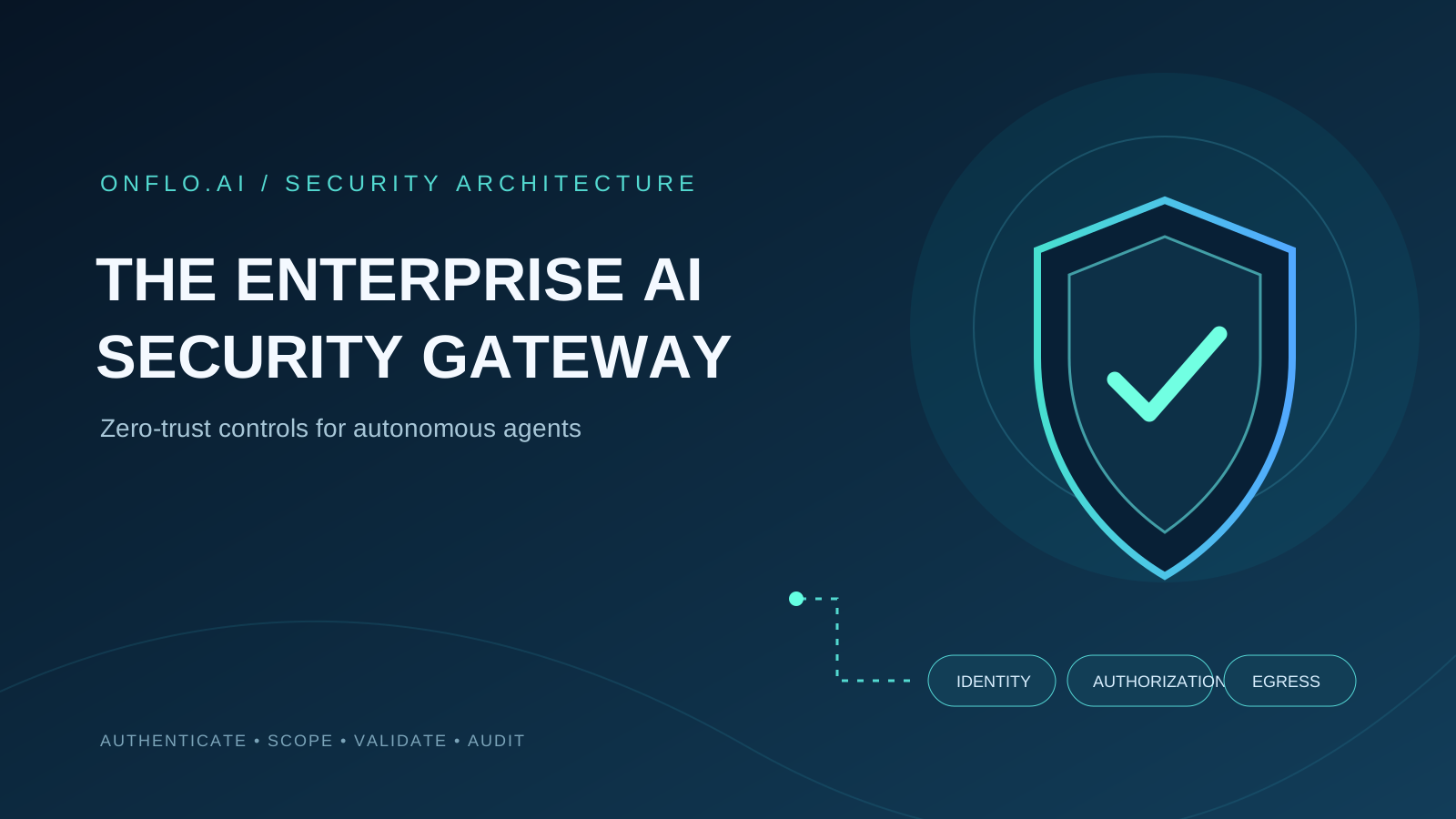
Koios positions its gateway as a defense-in-depth layer between agent execution and organizational systems. Its platform messaging describes identity verification, relationship-based authorization, tenant isolation, sliding-window rate limits, schema validation, SSRF egress defense, credential protection and execution auditing as parts of that control surface. The general lesson: make the gateway—not the language model—the authority that permits or blocks an action.
Why an agent call is a security-sensitive request
An agent can select tools dynamically based on user input and its reasoning. If the tool layer trusts a model-produced URL, identifier or operation without independent checks, prompt injection or a mistaken plan can become an outbound request or data access.
Answer three questions for every call:
- Who? Bind the operation to an authenticated user, service identity and organization context.
- What? Enforce permissions on the specific resource and action, not merely the agent’s broad role.
- Where? Restrict destination and network scope before an outbound request.
Layer controls instead of trusting a single guardrail
A prompt instruction such as “never access internal systems” is useful guidance, not a network control. A role check alone does not establish which department’s records can be read. A rate limit does not block a sensitive destination. Defense in depth combines distinct checks so failure in one layer does not grant the entire operation.
Establish identity and organizational scope
Start with a verified caller and carry that identity through execution. Relationship-Based Access Control (ReBAC) expresses access through organizational relationships and resource scope rather than only a flat administrator/user distinction. Koios messaging emphasizes organizational hierarchies and scoped agents, knowledge bases, files and connectors. Authentication must not automatically authorize access to every tenant or department.
Constrain the request before execution
Validate tool arguments against an expected schema, apply action-level authorization, and rate-limit repeated or excessive invocations. These checks address different risks: schema validation limits malformed inputs, authorization limits what a caller can do, and rate controls help contain runaway loops or abuse. Consider limits at user, organization and connector boundaries when work fans out across agents.
Make egress policy explicit
Server-Side Request Forgery (SSRF) occurs when a server is induced to contact destinations the requester should not reach. Agent tools that accept URLs need destination controls at the point of connection. Koios messaging calls out blocking private address ranges, loopback destinations, internal hostnames and cloud metadata endpoints such as 169.254.169.254. Validate resolved addresses and redirects, then re-check the final destination before connecting.
A hostname can look public while DNS resolution, redirects or address changes reveal a different target. Egress controls belong in a trusted gateway or proxy that sees the resolved target—not solely in a prompt or an initial string check.
Keep secrets out of model and workflow contexts
Agent runtimes should receive only the data needed for their step—not master connector credentials. Koios describes a backend proxy pattern in which the execution runtime does not receive master API keys; the backend signs connector requests and sanitizes returned data. That can reduce the blast radius of prompt exposure and the number of components trusted with secrets.
Credential handling still needs encryption, rotation, least privilege and logs that do not echo secret values. A proxy wall is a boundary to design and verify, not a substitute for credential lifecycle management.
Observe decisions without leaking sensitive payloads
Security teams need to reconstruct who called which tool, against which resource, and whether the request was allowed. Record identity, outcome, policy-relevant resource identifiers, timestamps and trace context. Redact secrets and unnecessary personal or business data. Useful logs distinguish a policy denial from a connector failure and support investigation of repeated denials or unusual egress attempts.
A practical request flow
Agent proposes call → authenticate caller + organization → authorize action + resource → validate schema + rate → check resolved egress destination → proxy attaches protected credentials → connector executes → sanitize response + auditEach arrow represents an enforcement boundary. Fail closed when required identity, authorization or destination information is missing. Make denials legible to operators while returning only what the agent needs to recover safely.
How to assess an enterprise AI security gateway
| Control question | Evidence to request |
|---|---|
| Can access be scoped to teams, tenants and individual resources? | Policy model, inherited/denied access examples and cross-tenant isolation tests. |
| Can tools reach arbitrary URLs or internal addresses? | Egress policy, DNS/redirect handling and private-network/metadata endpoint tests. |
| Can an agent expose reusable credentials? | Secret-flow diagram showing which components can access credentials. |
| Can runaway activity be contained? | Rate-limit behavior, concurrency controls and recovery procedures. |
| Can investigators reconstruct decisions? | Redacted audit examples and retention/access controls. |
Request evidence from test environments and verify failure behavior for missing identity, denied scope, malformed arguments and prohibited destinations.
Put the gateway in charge of execution
A zero-trust Enterprise AI Harness separates model reasoning from enforcement. The model can propose an action; the trusted runtime must establish identity, authorize scope, validate shape, constrain destination and record the result. Layered controls make autonomous capabilities easier to govern without treating a prompt as a security perimeter.
Related reading: Just-In-Time Tool Discovery and SingleFlight request coalescing.