Surgical Diff Patching: Safer, Leaner AI File Edits
When an agent only needs to change a few lines, rewriting an entire document is wasteful and needlessly risky.
Enterprise agents increasingly edit configuration files, reports, code, and visual-canvas documents. Yet a small requested change can trigger a large response: the model regenerates a complete file when only one value or paragraph needs attention. This mismatch wastes output tokens, adds latency, and risks changing material outside the task.
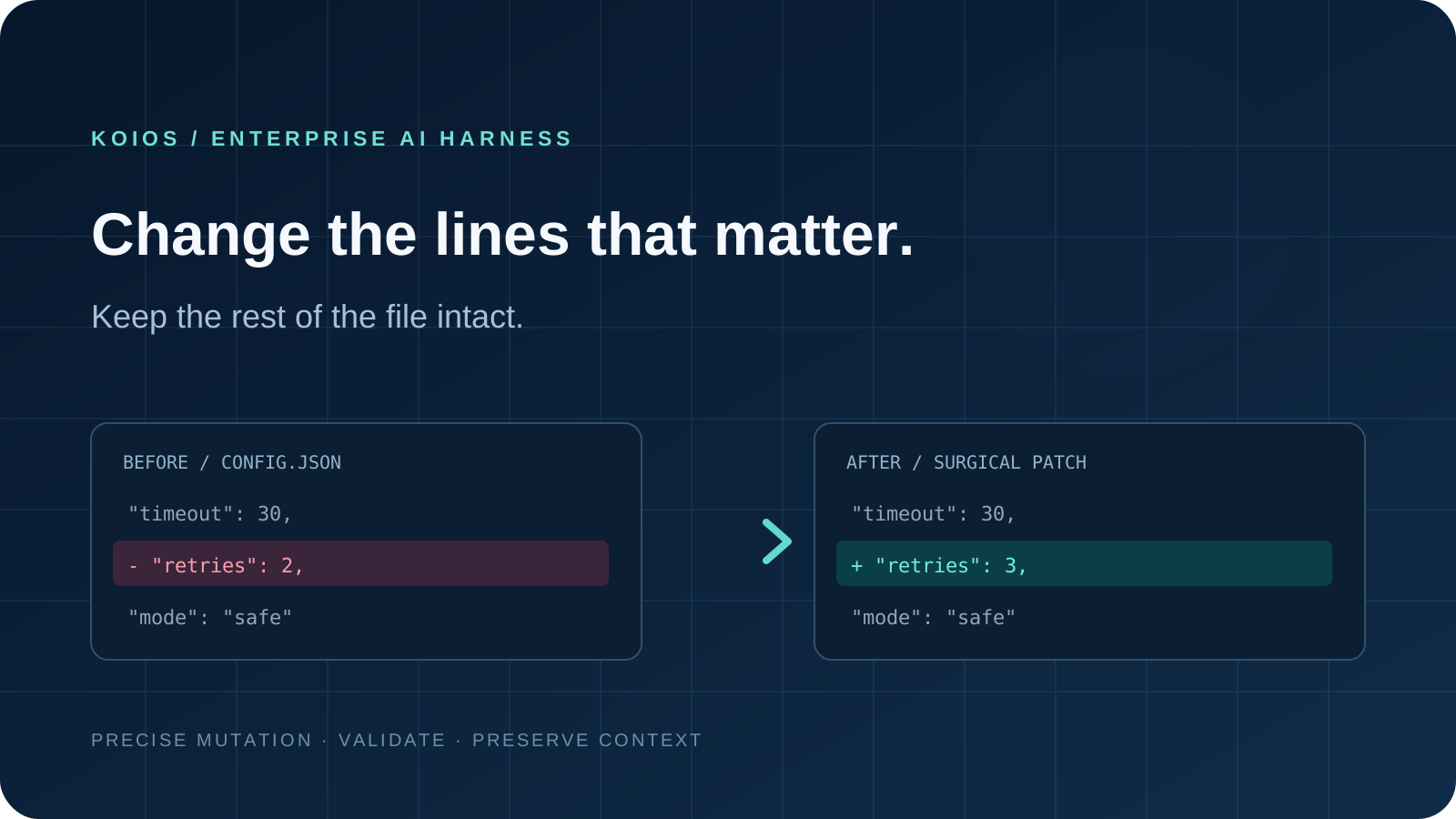
Surgical Diff Patching narrows the operation. The agent identifies a target and proposes a limited replacement; a workspace operation applies only that mutation while preserving surrounding content. Koios provides patch and patch-text in its Workspace CLI for targeted edits. Canvas workflows can similarly update selected objects instead of replacing an entire design.
Why whole-file regeneration is a poor default
Suppose a production workflow must change a timeout in a long JSON configuration. A full rewrite forces the model to reproduce every key, nested object, and formatting decision. Most output carries no value for the change itself. The larger the document, the more chances there are for an omitted field, altered value, malformed structure, or unwanted diff.
Full replacement can be appropriate when a complete rewrite is requested or the source is short. For localized maintenance, it expands the change surface unnecessarily. Engineers want to know exactly what changed—not re-review thousands of lines for a one-line adjustment.
| Full-file regeneration | Surgical mutation |
|---|---|
| Model emits the complete document. | Model targets only the intended change. |
| Unrelated regions may drift. | Unchanged regions stay outside the patch. |
| Review spans a broad output. | Review focuses on a small, explicit diff. |
| Large output can increase latency. | Smaller mutations need less generated content. |
How precise patching works
A safe patch workflow has four steps: read enough context to identify the target; specify an unambiguous match or range; apply the replacement; then validate the result. The model proposes the change, but the editing operation should enforce its own match and write semantics.
Anchor on a specific text fragment
When the desired text is distinctive, specify exactly what to find and replace. This works well for localized edits if the match is unique and the operation fails closed rather than guessing when it is not. Afterward, parse structured data and inspect the diff. Success means the intended field changed and the document remains valid—not merely that a tool returned without error.
Use line-aware or text-aware patching
Koios exposes patch and patch-text workspace operations for controlled replacement. Line-aware edits are useful when a stable range is known; text-aware edits work when a distinctive snippet is the better anchor. Neither removes the need to read context: a small edit can still change the wrong section.
Update visual documents by object
For a Fabric.js canvas, changing a text label need not regenerate the entire canvas JSON. Canvas-aware operations can identify an object and update selected properties while retaining its frame and neighboring layout. Koios tooling includes canvas inspection, object updates, validation, and preview workflows. Identify the affected object, apply the limited change, then inspect the rendered result.
Smaller changes reduce—but do not erase—risk
A constrained patch limits accidental rewrites but does not guarantee correctness. The target can be wrong, the change can violate a schema, or a valid edit can be unsafe in production. Safeguards belong around the model proposal.
- Require a clear target. Resolve ambiguous matches before writing.
- Validate constraints. Parse JSON, run linters or schema checks, and enforce application rules.
- Fail closed on stale context. If the source changed and no longer matches, re-read instead of guessing.
- Keep a reviewable diff. Verify the actual before-and-after change.
- Use versioning and recovery. Preserve a restore path for consequential artifacts.
- Authorize at the write boundary. A proposed patch is not permission to modify protected files.
Operational principle: Minimize the mutation surface, then validate the artifact—not just the patch request.
Where patching fits in an Enterprise AI Harness
Surgical Diff Patching is most useful within an Enterprise AI Harness. The harness manages the boundary between reasoning and real changes: the model inspects the workspace and proposes an edit, while the runtime and organization define which resources are in scope.
Task request → read relevant file or canvas objects → select precise target and replacement → apply limited workspace patch → validate syntax, policy, and output → review or record the resulting diff.
This complements context management. Workspace files let an agent query relevant portions of large payloads instead of carrying all bytes through every reasoning step. JIT tool discovery follows the same principle: inspect the capability needed rather than loading every integration upfront. See our guide to Just-In-Time Tool Discovery.
Measure quality alongside token use
Compare equivalent tasks and record more than output tokens: generated tokens and latency per successful edit; patch success and ambiguous matches; syntax or test failures; unintended changes; human review time; rollback frequency; and policy violations. Savings depend on file size, target size, structure, and required context. Do not assume a universal percentage—measure representative work and report results.
| Signal | Possible cause | Response |
|---|---|---|
| No match | Source drift or stale target | Re-read and identify the current target. |
| Multiple matches | Anchor is ambiguous | Narrow the context or select a specific object or range. |
| Validation fails | Syntax or domain invariant broken | Reject or repair with validation; do not publish blindly. |
| Unrelated diff | Mutation scope expanded | Revert and apply a smaller patch. |
A practical adoption checklist
- Choose a workflow with repeated localized edits.
- Identify file formats, access boundaries, and validation steps.
- Expose clear read and targeted-write operations.
- Specify behavior for missing or duplicate matches.
- Keep authorization, backup, and audit controls outside the prompt.
- Measure results against full regeneration on the same tasks.
Conclusion: make the requested change, not a new document
Whole-file regeneration is disproportionate to many maintenance requests. Surgical Diff Patching narrows edits to the lines or objects that need to change, making output smaller and diffs easier to review. Combined with syntax checks, authorization, versioning, and clear failure handling, it gives enterprise agents a disciplined way to modify operational artifacts.
Koios brings targeted workspace and canvas mutation into its Autonomous Agent Operating System and Enterprise AI Harness. Start with a measured pilot: select a real workflow, enforce precise targets, validate every result, and compare both cost and change quality.
Further reading: Git diff documentation · JSON Schema documentation · AI agent observability